|
|
 | |  |
|
|
| | |
 |
|
|
We thank you for your relentless and dedicated efforts to help pass the Magna Carta for Household Helpers. However, it still faces difficulties in the Senate and a looming deadline before the elections come May 2004. To help spread the spirit of the magna carta, click the poster and sticker icons below to have your own print ready copies at home.
| |
|
| |
| |  |
| |
|
ACT NOW
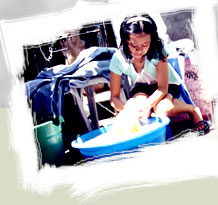
Child domestic work is one of the most disturbing features of Filipino
life. It is disturbing because of its very nature - domestic work
performed by a child, increasingly by very young girls, some as
young as 8 years old, isolated and separated from their families.
It is also disturbing because of the high incidence of deceptive
recruitment and trafficking that characterize it. Finally, it is
disturbing because of the very exploitative work conditions that
also make these children vulnerable to sexual abuse. | |
| In 1995, the National Statistics Office found that there were at least
766,000 domestic workers in the Philippines. Of these, at least 301,701 were 19
years old or younger. As the surveying government agency cautioned, however, these
figures refer to paid domestic workers: this does not include children who work
in exchange for room and board, or for the chance to study. | |
It is difficult to count how many child domestic workers there are.
In the first place, labor force and employment statistics gathered by the government
capture only those who are at least 15 years old. In the second place, enterprises
employing 10 or less are classified in the informal sector. Even domestic work
or domestic workers are included in the industries and occupations of the informal
sector. In addition, employers and their domestic workers who are kin do not report
employment, and neither do employers who pay their child domestic workers in the
form of schooling or room and board instead of cash. In short, child domestic
workers are statistically invisible. |
|