 |  |  |
| |||||||||||||||



| |||||||||||||||||||||||||||||||||||




| |||||||||||||




| The Southeast Asia Capacity Building towards sustainable Advocacy for Child Domestic Workers
The Southeast Asia Capacity Building towards Sustainable Advocacy for Child Domestic Workers is scheduled this 13-17 October 2003 at the Traders Hotel Manila. The workshop aims to generate a common understanding on the urgency and requisites of effective advocacy on the issue of child domestic work in South East Asia. It also aims to provide a venue for sharing experiences among partners in the region. | |
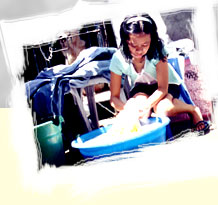
Child domestic work is perhaps one of the oldest forms of child labour and is widely spread in Asia. Several estimates of child domestic workers' pervasiveness have been forwarded despite the lack of comprehensive national data: 1.2 million in Bangladesh; 1.5 million in Indonesia; 1 million in the Philippines; 62 thousand in Nepal, and; 100 thousand at least, in Sri Lanka. Child Domestic Workers (CDWs) are large in numbers, yet remain invisible and marginalized both economically and socially because of the myths still surrounding their employment. Domestic work is believed to be safest for children because they are working inside households and may get a chance for schooling. However, many children have turned out to be victims of physical, verbal and sexual abuses. Many children in domestic work also fail to attend and survive schooling because of their special situation. They comprise a large percentage of the domestic workers' sector. Most are working in conditions that can be considered among the worst forms of child labour. They are totally under the control of employers whose primary concern may not be in their best interests as children. Many children are trafficked into domestic work, which can also lead them into other worst forms of child labour. Child domestic work is therefore a crosscutting issue about child rights, child labour and gender. And it requires right approach and strategy in order to address it effectively. In this light, advocacy is an important strategy to address the issue of child domestic work. There is a need to raise consciousness among decision-makers and the general public and individual employers by challenging myths still surrounding the employment of children in domestic work. While advocacy may be very broad and encompassing and requires scarce resources, experiences of practitioners, most NGOs believe that it can be effectively directed at least to employers, other key influencers, and child domestic workers themselves aiming at prevention and withdrawal from work and to receiving proper rehabilitation and education. This contributes to the primary goal of ending domestic child labour, or the extreme forms of child domestic work considered as among the worst forms of child labour. Generally, the advocacy workshop aims to bring the decision-makers and key players for concrete policy changes on the issue of child domestic work in South East Asia. Specifically, it aims to encourage the participants to come up with national and regional plans in the areas of public and private advocacy, legislative and policy advocacy, the education agenda and engaging in national time-bound programs reflective of ILO Convention No. 182 on the worst forms of child labor. This initiative will be a part of the capacity-building and lobbying agenda of the Task Force on Child Domestic Workers in Asia and on-going efforts of ILO-IPEC in the areas of child domestic work. The framework for the workshop encompasses the principles highlighted in Anti-Slavery International's advocacy handbook on the CDW issue; A handbook on Advocacy, Child domestic workers: Finding a voice. The principles articulated in the handbook have been tested in actual campaigns by the partners of ASI, many of who are members of the Task Force CDW and ILO-IPEC partners. There will be about thirty-five (35) high-level participants, comprised of ILO's tripartite constituents (government, workers and employers) and NGO officials from eight (8) countries mainly from South East Asia (Philippines, Thailand, Vietnam, Laos, Cambodia, Indonesia, Mongolia and China). The participants will be expected to learn from the experience of Visayan Forum and other countries. They will also draw out from concrete experiences some basic tools to measure the impact of advocacy. These success indicators will also be used during the last workshop that will focus on designing plans for future advocacy action at national and sub-regional levels. Visayan Forum Foundation, Inc. (VF) is the lead convenor of the Task Force Child Domestic Workers in Asia within the network of the Child Workers in Asia (CWA). Since 1997, it launched significant efforts to highlight the issue in the region. The Task Force is composed of at least 15 NGOs working with CDWs in 11 countries. In 2002, VF hosted a 2nd regional consultation of the Task Force to forge a common agenda for the next three years. A preparatory seminar entailed Legislative Advocacy Seminar highlighting the experiences in lobbying the Batas Kasambahay or the Magna Carta for Domestic Workers in the Philippines. An Exchange Program followed for task force members to learn good practices from first hand visits of the Visayan Forum's project sites and partners. Child Workers in Asia (CWA) was established in 1985 as a support group for child workers in Asia and the NGOs working with them. It now brings together over 50 groups/organizations working on child labour in 14 countries. It facilitates sharing of expertise and experiences between NGOs and strengthens their collaboration. Anti-Slavery International (ASI) is the world's oldest human rights organization and has undertaken research into the situation of child domestic workers in Bangladesh, Benin, Costa Rica, India, Indonesia, and Togo. It produced a handbook, Child Domestic Workers: A Handbook for Research and Action in 1997 to promote good research and follow up action on awareness raising and prevention. This handbook and its recommendations have been widely circulated and Anti-Slavery has worked with other NGOs from around the world to promote their implementation. Anti-Slavery has also advised the IPEC program of the ILO, UNICEF and Save the Children UK on the issue. Global March Against Child Labor is a worldwide campaign against the exploitation of children and their deprivation from education. It has been relentlessly working to generate and sustain national attention and action on child labor, especially in the areas of policy and legislation and mobilizing other sectors. The Global March movement was instrumental in the unanimous adoption and ratification in many states of ILO Convention 182 on the Worst Forms of Child Labor The International Labor Organization-International Program on the Elimination of Child Labor (ILO-IPEC) launched a global program that supports national actions to address the vulnerability of CDWs. Apart from the pilot direct interventions at the country level, ILO-IPEC has been making efforts to build capacity of national counterparts to fight against exploitation of CDWs regionally. One example of such initiatives is the ILO/Japan/Korea Tripartite Meeting on Child Domestic Labour in Asia and the Pacific held in October 2002 in Chiang Mai, Thailand. The meeting yielded an output - a Framework of Action to Combat Child Domestic in the Asia and the Pacific Region, which was adopted unanimously by the participants from 16 countries. In this occasion, two technical reports were also published; Study on the Legal Protection of Child Domestic Workers in the Asia-Pacific, and an Overview of Child domestic Workers in Asia highlighting the experiences in the field. Opening Ceremony
Ritual Presentation by Child Domestic Workers Philippine National Anthem Welcome Remarks
Messages from Organizers
Keynote Address
Master of Ceremonies:
(A press conference follows at 10-11 am) | |
| Workshop Programme (5 days)
Day 1: October 13 (Monday) | |
| Arrival and Hotel Check-In (Traders Hotel Manila) | |
| 4:00 p.m. | Registration (Venue: Ambassador Sala, 2nd Floor) |
| 7:00 p.m. | Dinner |
| 8:00 p.m. | Expectations Check / Orientation |
|
Day 2: October 14 (Tuesday) | |
| 8:00 a.m. | Opening Ceremonies (please see separate program) |
| (Venue: Ballroom B, 2nd Floor) | |
| Press Conference | |
| (Venue: Ballroom B, 2nd Floor) | |
| THEME 1: | INTERNATIONAL FRAMEWORK |
| (Venue: Ambassador Sala, 2nd Floor) | |
| ILO Action Framework on CDW Issue
Ms. Panudda Boonpala Senior Child Labor Specialist, ILO Sub-Regional Office for East Asia Ms. Tine Staermose, ILO-IPEC Headquarters |
|
| Open Forum | |
| 12:00 - 1:30 p.m. | LUNCH BREAK |
| THEME 2: | LESSONS LEARNED FROM EXISTING ADVOCACY EFFORTS |
| 1:30 p.m. | Panel of Discussants |
| Influencing International Policies and Action
Ms Toko Tomita Campaigns Coordinator, Global March Against Child Labor |
|
| Philippine Experience with the National Program on CDWs
Ms. Ma. Cecilia Flores-Oebanda President, Visayan Forum Foundation Inc. Time Bound Programming and Research
Children's Participation in CDW Agenda
Connection of CDW issue and Trafficking
|
|
| Open Forum
Snack Break |
|
| THEME 3: | TOOLS FOR MEASURING IMPACT ON ADVOCACY |
| 4:15 p.m. | Highlights of the Handbook for Advocacy on CDWs
Mr. Jonathan Blagbrough Child Labor Officer, Anti-Slavery International Open Forum Synthesis of the Day |
| Day 3: October 15 (Wednesday) | |
| 8:00 a.m. | Distribution of Copies of Synthesis
and Administrative Announcements |
| THEME 4: | NATIONAL AND SUB-REGIONAL ADVOCACY RECOMMENDATIONS |
| 8:30 a.m. | Clarifying Instructions for Group Work Series 1 and 2
Group Work 1: Brainstorming Country Proposals Group Work 2: Cluster Discussions Cluster 1 reporting |
| 12:00 - 1:00 p.m. | LUNCH BREAK
Cluster 2 reporting Cluster 3 reporting |
| 3:15 - 3:30 p.m. | Snack Break
Plenary, starting with Reports synthesis by Organizing Committee Overall Workshop Synthesis |
| 6:00 - 7:00 p.m. | Early Dinner |
| 7:00 - 9:00 p.m. | Closing Program
and Solidarity Night with Philippine Partners (please see separate program) |
Day 4: October 16 (Thursday) Field Exposure Trips | |
| 7:45 - 8:00 a.m. | Meeting at the Hotel Lobby |
| 8:30 - 9:30 a.m. | Visit to Visayan Forum Main Office
Interaction with Staff and Leaders of SUMAPI (domestic workers organization) |
| 10:30 - 11:30 a.m. | Visit to the Visayan Forum Halfway House for Trafficking Victims,
Manila North Harbor Interaction with members of the Taskforce Anti-Trafficking at the Ports |
| 12:00 nn - 1:00 p.m. | Lunch on board a shipping vessel |
| 2:00 - 4:00 pm | Courtesy Visit to the Philippine Senate
Senate President Franklin Drilon Senator Ramon Magsaysay, Vice Chairman, Committee on Labor and Employment Congressman Jackie Enrile, Author, Magna Carta for Domestic Workers, House of Representatives Dialogue with key Senate Legislative Staff |
| 4:00 - 5:00 pm | Debriefing |
| 5:00 - 8:30 pm | WOW Philippines Tour: Destination Intramuros |
Day 5: October 17 (Friday) Hotel Check Out (before 12 noon) Airport Departures | |
|
Closing Programme & Solidarity Night
Closing Ceremony and Solidarity Night October 15, Wednesday, 7:00-9:00 p.m. Venue: Ballroom B, Traders Hotel Manila, Roxas Boulevard, Pasay City Creative Presentation by Child Domestic Workers Reflections
Response from the Organizers Message
Inspirational Address
Distribution of Certificates and Tokens of Appreciation Ceremonial Closing Ritual Socials | |






