 |  |  |
| |||||||||||||||



| |||||||||||||||||||||||||||||




| |||||||||||||




|
|
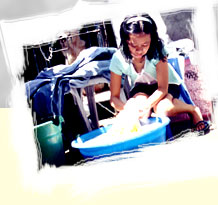
| World Day Against Child Labour 2004 Focuses on Child Domestic Workers For Every Child Domestic Worker, Schoolwork before Housework On June 11, Friday, the Visayan Forum Foundation, with 1,000 child domestic workers and social partners, will stage a candle light vigil at 6pm. The candle light vigil is the highlight of national and regional campaigns to be participated in by child domestic workers, child labourers, government agencies, partner NGOs, employers' groups, church and faith-based organizations, student organizations, and local governments calling the public's attention to the plight of "modern-day slaves" - the child domestic workers. The candlelight will symbolize our national commitment to make the invisible, ignored, and neglected child domestic workers visible, recognized and protected. In Manila, the group will converge during an afternoon forum at the San Beda College and will then proceed to Mendiola to stage street drama and other creative actions, culminating with the simultaneous lighting of candles from Mendiola, Batangas, Davao, Bacolod, and other parts of the Philippines. Partners from across Asia are called upon to hold similar vigils to demonstrate international solidarity in our demands for respect for the rights of child domestic workers, particularly on their right to quality education. The public is encouraged to light a candle in front of their houses in solidarity to the nationwide and worldwide clamor to give child domestic workers a chance to place schoolwork before housework. Employers will be encouraged to light a candle in front of their homes as a symbol of their commitment to recognize the importance of domestic workers and as a commitment to join concerted actions to further the rights of these children. The vigil is in line with the celebration of the World Day Against Child Labor where the International Labour Organization (ILO) and social partners from around the world will focus on the plight of child domestic workers by launching a groundbreaking report in Geneva and by holding simultaneous mass actions. In the Philippines, the vigil on June 11 is a timely event that will happen on the eve of the annual Independence Day celebration. It will also come at a time when the country just ended a national election and is now preparing for a new phase in its government history.
Of the 200 million children working around the world, recent studies and estimates from the ILO show that there are more girl-children under the age of 16 who are involved in domestic labour than in other forms of work. Similarly, child domestic work is pervasive in Asia.
Aside from the magnitude of children involved in domestic work, the most alarming aspect is their conditions of work. They are hidden behind the closed doors of their employers' homes, where their situations have long been concealed from public view and where they elude inspection from authorities. Their invisibility, lack of negotiating power, and lack of awareness of their rights make Child Domestic Workers extremely vulnerable to exploitation, including physical, emotional, and sexual abuse. While it is clear that not all CDWs suffer abuse, neglect, or exploitation and that their working conditions may not necessarily be dangerous or inhumane, we should not ignore the fact that a significant number of CDWs face abuse and exploitation. As child domestic workers perform our household chores, they are deprived of their rights. They do heavy work for very long hours and are paid very little or no wages. They have no access to social protection and security. The supreme irony is that most of these children agreed to take these risks in exchange for the opportunity to acquire education. However, they soon realize that they are trapped in a 24-hour job and that the existing education system is not appropriate with the nature of their work. As a result, child domestic workers miss out on education and miss out on this last chance to better their lives. Child domestic work is considered as a worst form of child labor because the child:
As a worst form of child labor, child domestic workers require urgent action. Domestic workers contribute immensely to our economy. They make two-income households possible and, because of their sheer magnitude, they remit a large amount of money. Sadly, in the process of freeing their employers from household chores, child domestic workers are the ones who remain shackled and bonded. We owe them their freedom, not only because they are the invisible engine of the economy, but above all else, they are children. The over-all objective of the campaign is to focus public attention to the plight of the child domestic workers and take immediate action to address exploitative elements of their work. Special attention will be given to recognizing and taking action on the rights of child domestic workers to education - "schoolwork before housework."
The key symbol to this campaign is the act of lighting more than a thousand candles, done simultaneously across Philippine cities, and even across Asia. Imagine a stretch of candles from Manila to Lahore! Social partners will be encouraged to join the vigil or light candles in front of their houses and offices to show support. Employers will be urged to light a candle to show the public and their neighbors that their fellow employer have committed to help ensure the recognition of the rights of child domestic workers. These many flames, from the Philippines, from across Asia, and from around the world, will become one big flame that will serve as a beacon of hope and consume the darkness that has engulfed the lives of millions of child domestic workers worldwide. To help highlight the campaign symbol, a series of activities will be conducted in major cities in the Philippines.
Media Notes (For Philippines Only) At age 9, Helena quit school and became a baby sitter to her employers' three children. Everyday waits for her wards at the school gate, and this is the closest she could have gone to school. Unable to read and write, she has watched her dream of education vanish before her very eyes. Junie, 15 years old, a domestic servant in Batangas considers herself lucky because her employers allow her to go to school at night. But she can barely keep up because they expect her to do housework before and above her studies. She might not enroll this June. Junie and Helena are among the shackled young workers found in our own homes. There are more than one million domestic workers in the Philippines, according to Visayan Forum estimates. Visayan Forum is an NGO providing counseling and legal services, educational alternatives and recreational outreach to abused domestic workers since 1996. Many child domestic workers are victims of physical, verbal and sexual abuses. They suffer very long working hours, and are always on call. They perform all-around chores, often with multiple employers. Isolated from family and peers, they rarely leave their employers even when they suffer abuse. They have limited days off and too little freedom for adequate time off and to transfer to other jobs. Performing all-around and adult chores, they are also expected to work until late in the evening. They have too little or no pay or adequate compensation. Average income still remains at P800 a month in Manila, to as low as P500 in other provinces. Many child domestic workers have the continuous need for salary advances and can easily fall into debt bondage situation. Working always on call even at night, many are discouraged to pursue schooling because they become too tired to survive the demands of formal education. Ironically, many parents and children themselves believe that domestic work may be the safest job available because they would get to work inside the home. Many recruiters take advantage of this belief to easily lure young women into prostitution and other exploitative work. Invisibility and scatteredness of these working children and their lack of awareness about their rights remain the major hindrances to effective action. Lack of national data and cultural acceptance to domestic work reinforces its long-standing preclusion in national policy. And because enforcement would be very difficult in private homes, policies and laws remain outdated despite recent efforts to lobby for new laws such as the Batas Kasambahay. Realizing their role in freeing their employers from repetitive house chores, and valuing their remittances to their cash-stripped home provinces, many domestic workers have taken a strong stand to demand attention they have long deserved. |






