 |
 |
 |
|
 |
||||||||||||||



|
|||||||||||||||||||||||||||||




|
|||||||||||||




Labor Day for maids' employers too For Immediate Release
|
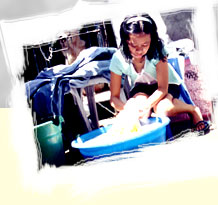
As the public expects traditional mass actions come Labor Day, there is one private issue now left to be in sight and in mind. More than half of all people who live in cities and other urbanized centers - around a million households according to reliable estimates -- privately employ domestic workers who remain hidden from national laws. There still remains a vast army of everyday domestic workers who maintain the comfort and enjoyment of the homes by freeing employers from the routine but necessary tasks of cooking, cleaning, ironing and washing. Domestic work is deeply rooted in our social fabric. Most consider domestic workers as extension of the family, while some still relegate them to slavery. On one hand it is secondary, undesirable and marginal, for it is the work that the domestic workers' employer cannot be totally bothered with. On the other hand, it is supportive and necessary to everything else that the employer does, for he has gone out and hired someone else to do it for him. Domestic workers remain statistically invisible. No institution has reached a precise figure and dispersion. But by their sheer number - one million, according to Visayan Forum Foundation (VF) estimates - and by the gravity of abuses increasingly reported to and handled even to government crisis centers, these workers can no longer be ignored. VF is an NGO providing specialized services to young domestic workers for the past five years with the help of the International Labour Organization - International Programme on the Elimination of Child Labor (ILO-IPEC), lobbying for national laws and programs, and working with employers to improve practices like registering their house helpers to the Social Security System and supporting alternative education and trainings. |
The plight of local domestic workers According to VF, domestic workers contribute to national income and productivity as labor multipliers and cash remitters to poor countrysides, domestic workers remain hidden despite increasing global attention to the informal sector. If this one million workforce remits at least half their average salary of P800 a month, they would be silently infusing some P400 million a month or P4.8 billion a year to their cash-stripped families in the provinces. They are mostly girls working away from home and are vulnerable to physical, verbal and sexual abuse. They are always on call. Many are still sold or trafficked, work in bondage or without pay, work for long, indefinite hours in isolation and often at night. The very young seldom continue their education if allowed by their employers because they shoulder their own expenses and still maintain the same workload. Unfortunately, the treatment of domestic workers is arbitrary and is not governed by any socially accepted minimum standards. There are no formal contracts to speak of in the first place because many agree to work under such informal terms through very informal recruitment channels. |
Why a Househelpers' Day? Two years ago, VF started a unique annual getting out event for domestic workers on the eve of Labor Day dubbed as "Araw ng mga Kasamabahay" or househelpers' day. The event kick-launched in 2000 to campaign for Batas Kasambahay, a proposed magna carta sponsored by Congressman Enrile of Cagayan and Senator Loren Legarda that sets minimum standards of treating domestic helpers with special focus on the very young. This year's celebration demands attention to the neglected kasambahay bill slumbering in the legislative mill for almost two years now. More significantly the organizer would to stress the important role of employers in recognizing these workers as household partners (kasama sa bahay) and family members (kapamilya) and for society to recognize their silent national contribution, hence the term "kasambayan" or national partners. There will be simultaneous celebrations come April 28 at the Quezon City Memorial Circle, Bacolod Reclamation Area Gymnasium, and Assumption College of Davao. On May 5, VF will also lead a multi-sectoral campaign at the Batangas Basilica Gym with the official participation of the Batangas Diocese, Couples for Christ, DOLE, DSWD, TESDA, BCNHS and Shell. The Davao launching will be highlighted by the opening of a half-way house at the Sasa Port, built by the Philippine Ports Authority to help stem trafficking and illegal recruitment of women and children from the Mindanao regions. |
More than the term "kasambahay" There is more to changing the degrading term katulong widely used for domestic worker and encouraging the general public to use the term kasambahay or 'household partner.' Changing social attitudes requires social transformation that transcends the power relations in the employer-employee arrangement and in striking a balance of benefits in the exchange of loyalty and services inside this home arrangement. Many factors hinder action and to justify the historical neglect of domestic workers. These include lack of comprehensive national laws and programs, the statistical invisibility of domestic workers due to lack of reliable data, the inadequacy of civil society initiatives and lack of social awareness about the issue. Many domestic workers themselves do not know their rights. And even if they do, many think twice of exercising these rights out of fear of angering their employers. The employers' high social standing and superior financial strength can also discourage victims to seek redress. It is therefore important to work in the long-term to preserve and improve employer-employee relationship that is central to sustaining both the interests of the employers and domestic workers themselves. Aside from calling for the immediate enactment of the Batas Kasambahay, VF also believes in attacking distortions to the practice such as trafficking and illegal recruitment, slave-like conditions, and hazardous working conditions that compromise the health, safety and morals especially of the very young. |






