 |  |  |
|  | ||||||||||||||



| |||||||||||||||||||||||||||||




| |||||||||||||




Combating Child Trafficking To combat child trafficking in the country, domestic shipping company William, Gothong and Aboitiz (WG & A) has agreed to set up a monitoring scheme for passengers of its popular Super-Ferry vessels. |
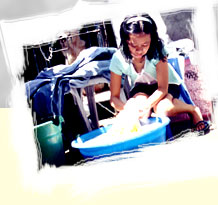
The safety net will be put in place initially at the Manila North Harbor and will, as much as possible, intercept potential victims of child trafficking - estimated at around 2.5 million every year - upon their arrival at the waiting area. The program will be implemented in coordination with the Visayan Forum Foundation, Inc., a non-governmental organization promoting the welfare of migrant working children from Visayas and Mindanao. Similar arrangements have been made with other shipping firms such as Sulpicio Lines and Negros Navigation. In an interview with Business World, Roland Pacis, VF Project Officer, said volunteers manning several "catchment networks" will roam around the North Harbor's waiting areas to spot potential victims, usually huddled in groups and led by an "adult minder." "Often, you'll see them seated in one corner. They seem to be unfamiliar with each other. But when you go and ask them, they'll say they're relatives." The "hard approach" in intercepting suspected victims, he said, is done by police who invite the adult minder (who is employed by the recruiter) and the children to the police station for questioning. In the "soft approach," meanwhile, volunteers befriend suspected victims before asking where they are supposed to live or work in Manila. A joint halfway house, the "Bahay Silungan sa Daungan," run by the VF and the Philippine Ports Authority (PPA), has been providing 24-hour relief services for child trafficking victims since last year. Locate beside the PPA office in Pier 8, this "safe haven," Mr. Pacis said, gives temporary shelter, information assistance, employment, and legal assistance. Research by the VF shows thousands of vulnerable children from Visayas and Mindanao end up as victims of labor and sexual exploitation working in Metro Manila brothels, bars, sweatshops, and private homes. The victims are usually lured, according to VFF, by misinformation, deception, and fraud. Some unscrupulous recruiters even threaten the children to force them to engage in prostitution or menial household work. Mr. Pacis said a survey commissioned by the United Nations Children's Emergency Fund (Unicef) last year reveals six out of 10 children arriving at the Port of Manila give "suspicious" answers as to their destination or purpose of travel. Around four million domestic workers arrive by ship to Manila every year. Victims, according to VF research, are usually 15-to 22-year-old females, mostly first -timers carrying one-way tickets. Most end up as domestic workers because there is no need for employment requirements such as a college diploma or a birth certificate. Moreover, 13 out of every 20 children, or 65.7%, do not have a work contract upon arrival. Six out of 10 have their fares deducted from their salaries, and 19% could not speak or understand Filipino. Mr. Pacis said the monitoring program will be expanded next year to include other major ports. A monitoring system will also be put in the ports of origin to prevent child trafficking before transit. - Felipe F. Salvosa II |






