 |  |  |
| |||||||||||||||



| |||||||||||||||||||||||||||||




| |||||||||||||




| ARTICLES (ARCHIVES) Subject: Guidelines
for Hazardous Work and 12 August
1999 |
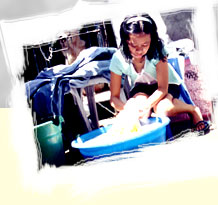
| Dear Secretary Laguesma, Child Labor is a problem that affect us all and it often seems that solutions to the problem are difficult to find. Your plan to issue a department guideline pursuant the cornerstone laws and policy framework, is commendable. It is also responsive to the new global cause to immediately eliminate child labor in its worst forms as manifested in the fresh ILO Convention 182 and its accompanying Recommendation 190. However, we had the chance to give the matter some serious thoughts and concrete action as the present Philippine Secretariat of the Global March Against Child Labor and as an NGO specifically directed to child domestic workers. After studying the draft of the department order (encolosed herein), we want to present to you some of our observations and proposals. One of our contentions focuses on Section 2, paragraph 10, which gives explicit exception to domestic workers or household service from the list of hazardous work conducted at night to early morning, or being on call anytime at night to perform services. In this light, we highly recommend the deletion of the phrase, "except domestic workers or household service as defined in Section 3 hereof who are on stay-in arrangement," to avoid misinterpretation and leeway for abuses that are made against child domestic workers. Our second contention revolves in Section 3 , which allows persons 15-18 years of age to engage in domestic/household work. Based on our work with the International Labor Organization funded project "Kasambahay," we have noted that most of the abuses we have handled occur among children at this age bracket. Our past and existing cases may not be as conclusive as hard facts, but taking into consideration the abject absence of such officially produced statistics, we feel it would be very wise to rest this provision to further consultations. We share with your cautious consideration to declare a blanket ban of domestic work of minority age (15-18 years old). In this light, we recommend to include in Section 3 specific working conditions that should not be allowed for them. These may include, as carried by ILO Convention 182 and Recommendation 190, the following:
This list is by far not comprehensive. We would be very willing to work in consultation with you to define such conditions, as we are also in the process of working out a magna carta on domestic workers with Congressman Jack Enrile that specifically tackles these concerns. The issue is very close to our hearts, and your feedback on the views we have shared will be highly appreciated. We are looking to your immediate attention to this matter. In our steadfast partnership with your office to walk for the rights of working children, from exploitation to education, from exploitation to freedom, we remain. Very sincerely yours, Ma. Cecilia Flores-Oebanda cc: |






