 |  |  |
| |||||||||||||||



| |||||||||||||||||||||||||||||




| |||||||||||||




| ARTICLES (ARCHIVES) News Feature |
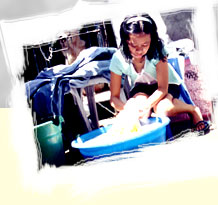
| Young Filipino House Helpers Plant the Seeds of Their Freedom April 30, Manila - Today is the eve of the first Labour Day of the millennium. It is already 9 p.m. at the Quezon Memorial Circle, but park frolickers, who are mostly maids, are still teeming around. This is unusual, as most of them would have left this favourite hangout during ordinary day-off before sundown. Today, though, hundreds of them are still lining up at the Social Security System (SSS) registration booth. A popular Filipino artist sings "Kasama" (partner), as a tribute to this group of workers' "silent sacrifices to productively contribute to social development by freeing thousands of women to have remunerative jobs outside the Filipino homes". The nation that has become increasingly sensitive to the plight of its own overseas domestic helpers has begun to look inward, too, to protect its domestic helpers on the local front. In 1995, it was estimated that there were around 866,000 maids in the Philippines, 36% of them were from 15 to 24 years old, and about 14,000 were below 15 years old. There could be more than a million maids working in the country today. They are a massive group of workers wrapped in silence, relegated by law, custom, and convention to the informal sector of the labour force, and deliberately excluded from legal protective rights accorded to other members of society. The coming out rally today signifies a growing clamour for social introspection, for lasting changes to start in this generation. A Magna Carta for house helpers locally dubbed as "Batas Kasambahay" now seeks to increase their minimum wage, provide for their 13th month payments, Social Security System coverage, assurances of days off from work, and requiring contracts for employment. Groundworking for Action: Outreach in the Park "We give a human face to an invisible, lowly regarded sector"says Maribel Pantajo, 16, the Secretary General of the Samahan at Ugnayan ng mga Manggagawang Pantahanan sa Pilipinas or SUMAPI, roughly translated as "association and linkage of house helpers in the Philippines". She started to work at 13. Constant physical and verbal abuse by her employer and her ward forced her to seek assistance through a telephone hotline network. For migrant house helpers who are confined to endless chores in endless days, always on call to perform services to satisfy their employers' personal needs, being a part of SUMAPI makes them finally heard. At times, their rallies and other policy advocacy actions are covered by television. They guest in radio programs or participate in strategic planning sessions of the various child labour networks in the country. They are most visible in the Luneta Park where most domestic workers frolic during their day off (Sunday) to meet friends and townmates. SUMAPI members would distribute flyers and facilitate flip chart orientations to any those interested, systematically combing through hundreds of people in the area, at the risk of being branded as fronts for illegal recruitment agencies themselves. Establishing a conspicuous presence in a public park, where people from all walks of life go, is nothing less than difficult. They started in 1995 as a rag tag band of rescued abused housemaids who were convinced that others could be prevented from falling into similar fate if they were aware of their rights and entitlements under the law. For the inexperienced migrant who is exposed to the jungles of urban life, knowing where to run in times of crisis is a key to survival. Chedita Marayag, now in her twenties, is among the few founders of SUMAPI. She started to work in a southern Philippine province since she was nine years old for a teacher. "My teacher was fond of excusing me from classes for me to do her afternoon laundry." she said. Having a sense of obligation towards her family and other sisters, she ventured into the Philippine capital as a full pledged domestic worker at the age of 14. She did tasks all day long for her employer, including secretarial services for the employer's home retail business, all in exchange for P800 a month ($20). Predictably, she was soon trapped in a cycle of debt accumulating from her salary advances so she could remit money to her family to support her sisters' education and her father's medication. As a solution, she allowed her 14 year-old sister to be similarly recruited and trafficked to Metro Manila, thinking that she would then be one less mouth to feed and educate, and would be able to contribute financially to the impoverished family. Through its outreach in Luneta, Visayan Forum met the two sisters and rescued them from bondage. They became a test case for the Kasambahay program of the organisation. The experience was an eye opener for Chedita. She knew that others have to be warned and protected. A diminutive and shy but uncompromising figure, Chedita was elected as the first President of the association. Although she was still displaying manifestations of a post-traumatic stress syndrome at that time, the experience gave her courage and helped her relate effectively with fellow domestic workers. "I can easily identify a fellow domestic worker," she beams. At the parks, Chedita would approach a young girl with a casual but deliberate greeting, "Bisaya ka, Day?" ("Are you a Visayan"). In a few minutes, she would blend with a group of park goers, then she would already be talking with them about their experiences as house maids. Her non-threatening, honest personality always disarm a fellow victim into a mood of personal sharing, which ordinary social workers could hardly do given the same opportunity. The crucial first three minutes of gaining the trust of domestic helpers is a moment where former victims-turned volunteers like Chedita can be the most effective. Only afterwards would the professional staff of Visayan Forum intervene. Practical orientation on program services and legal rights of workers have been designed by social workers and trainers to optimally suit the short attention span and availability of the domestic workers. The program further gains the trust of most domestic workers through participative and recreative venues such as volleyball games, fellowship meetings, chats over a plastic cup of refreshment, or simply conveying a warm good-bye as each go back to their employers for another week of confined work. Shoulder to Shoulder, a Partnership with the Visayan Forum While the park outreach with SUMAPI proved to be effective in establishing contacts, the real hard work begins at the office each Monday morning. Shoulder to shoulder with Visayan Forum staff, follow up of their new-found friends are planned and implemented by phone, by mail, and often by personal visitations to to the workplaces. Taking on the cudgels of child domestic workers, the Visayan Forum has embarked on a national program in four major Philippine cities since 1995- Manila, Batangas, Bacolod, and Davao-. It has trained its guns to provide direct services, support to organizing SUMAPI, and to advocate for policy reforms. Jenefer, herself a survivor of sexual advances and non-payment of wages, works well with Chedita in the area of psycho-social and legal interventions for abused housemaids. Together with other SUMAPI volunteers, she helps in everyday activities from organising field trips, retreats, and seminars, to aiding househelpers obtain approval for days off from their employers. "The most challenging aspect of my work is dealing with abused child housemaids who run into our center for refuge" she tells a group of NGO and government implementors during an ILO-Manila partners' meeting. Something inside her must have grown beautifully after her experiences in the temporary shelters, assisting social workers to manage the cases of victims of different kinds of assaults and girls who have suffered conditions often tantamount to slavery. "Someone woke up in the middle of the night, screaming and assaulting fellow transients. The nightmares kept coming back so I should always be there to comfort her," she takes on the advice of the social worker who also sleeps in the office. Jenefer is also effective in providing peer counselling to newly accepted victims. Thus, she is a popular big sister of many. Jenefer has also become adept with handling hotline cases. She can get crucial details of severe cases even during wee hours of the night or very early in the morning. By the office hour, a synopsis of the hotline case will have been available for the Social Worker to properly intervene. Piedpipers in Schools SUMAPI has grown to a formidable membership of at least 5,000 domestic helpers nationwide. To date, it is composed of seventeen (17) smaller, manageable chapters based in parks, waiting areas, churches, and schools in three other cities outside Metro Manila. Teamleaders are constantly trained to become effective facilitators of services, advocates, and group builders, despite the fact that there is a fast turn-over of domestic child workers at work. Milaluna, 17, has her share of sexual advances, and physical and verbal abuses from her employers. That did not deter her from pursuing a dream of education even if she had to transfer from one employer to another. Combining work and school, she was the chapter president of SUMAPI in Bacolod in 1999. "Most of my classmates are vulnerable to dropping out. Others come to class too sleepy and tired, others don't have money to buy school supplies to pay school fees," she observes. More than 80% of the students in her night class are housemaids. She was also elected as a governor of the night school. Through her leadership, psychosocial processing seminars, field trips, and classroom orientations on child rights and workers' rights were organised. "Others do not know their rights and are not even capable of recognising abuses at the workplace". Every year, SUMAPI also hosts a week-long art exhibit to conscienticize school children and their parents. Schoolteachers are crucial second parents, too. With recommendation of the SUMAPI core group officers, a fellow domestic worker suspected of being abused is better approached by the class adviser. The Visayan Forum also cooperates with all these actors to screen who are the most in need of immediate educational assistance. The presence of SUMAPI in alternative schools have helped create an atmosphere of trust, cooperation, and group sharing among domestic workers who normally carry their burdens individually. Lessons and Prospects of Participation among Girls The absence or limited awareness and understanding of their basic rights among the domestic child workers and the elder domestic workers remain an inherent problem. This is a hindrance to any direct service approach to any program. It is in this light that organisations of domestic workers, as in the case of SUMAPI, are important channels for advocacy and for provision of safety net mechanisms against abuses within their own ranks. Without any manifestation of organised action among housemaids, individual empowerment will almost be impossible. It is important for practitioners to develop skills in providing psycho-social interventions and skills in organizing. There is a need to develop the capacity to facilitate forums for the children and adults' participation in advocacy, and for creative self-expression. Finally, and most importantly, we should recognize that most domestic workers in the Philippines are very young. We are therefore talking of children and young people participating in matters affecting them, with all their strengths, effectivity, dedication, and also their limitations. NGOs working in partnership with them should know where they stand - shoulder to shoulder. With these and many more lessons we could further gain from continuous work, freedom for the domestic workers will not be too far away. As long as they see themselves as stakeholders, lives would be easier changed, and saved. |






