 |  |  |
| |||||||||||||||



| |||||||||||||||||||||||||||||




| |||||||||||||




| ARTICLES (ARCHIVES) Girl Child in Invisible Labour: Child Domestic Workers in the Philippines Presented
by ILO Briefing |
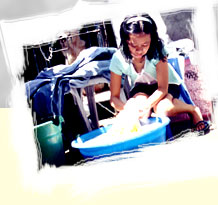
| For so long a time, our child domestic workers have been silent � neglected by society. Their scatteredness and invisibility make them one of the most difficult types of working children to protect. The social inequality and economic inequity in which child domestic workers find themselves in and the lack of political will, especially of governments, to put children first in their social agenda, reflect how society nurtures its future generation. Thank you for giving me this chance to speak before you and make the issue of child domestic workers be finally heard. I must admit, though, that a ten-minute presentation may be too short to depict the historical neglect of these children, a great number of whom are girls. The Problem The longstanding historical practices and perceptions, which give social acceptance to child domestic work, contribute to the ever-increasing number of these child workers. Employment arrangements are generally informal, which makes them scattered, invisible, separated from their families and difficult to reach. To reach them in their workplaces could be an intrusion into a private area. In Manila, Philippines, typical domestic workers are single females, aged 13 years old and above. They are usually migrants coming from poor agricultural or fishing communities in the provinces. They are mainly recruited by relatives, town-mates, friends or illegal recruiters. Many have previous work experiences in the provinces since the age of 8 years. Parents prefer to place their children in domestic service for they see it as a lighter and less arduous task than other employment opportunities available for children in their communities. Domestic work requires no formal training and schooling. To work in the city increases family status in the community and brings in much needed cash especially for an agricultural family. The employers on the other hand, see themselves as benefactors or guardians rather than exploiters of children. They prefer children to adults because the former are easier to manage, more submissive, hard working, less complaining, cheaper, and do not require basic social securities. The child workers serve as companions for the employers' children. There are no formal contracts of employment between the employers and the child domestic workers, making the latter vulnerable to indiscriminate termination from work. Domestic work is perceived as a lowly job, and the child domestic workers are among the lowest-paid of workers. Their wages - if paid at all - are usually delayed, and when received, are greatly reduced due to deductions made by the employers in payment of the cash advances of parents and recruiters. In many cases, children are forced to work as payments of their parents' debts to the employers. The workers receive a monthly wage ranging from P800 to P1,000, which is equivalent to about US$20. Many, as an obligation, remit their money to their parents to support the schooling of a brother or a sister. Parents usually ask their daughters to give way to a brother. Boys come first because it will be easier for them to find a job. Early on, the girls are being tacitly told that they have lesser chances for development than the boys do. Visayan Forum Foundation believes that the interplay of many factors, both macro and micro, contributes to the phenomenon of child domestic work. Poverty, underdevelopment in rural areas, worsened by unbalanced economic programs favouring globalisation, the expectation of helping parents, and supporting oneself to school are factors that trap many child domestic workers in this situation. Child domestic workers face serious difficulties to have equal chances to develop into productive adults. Many are not allowed to venture beyond the house gates. They are usually subjected to verbal intimidation, as well as to physical and sexual abuse. Their work conditions worsen their plight, working at an average of 15 hours a day and are on-call 24 hours a day whenever their employer want them to do something. Being mostly girls, many are easy targets of sexual assaults ranging from: lewd innuendoes, perverse behaviour, molestation which definitely introduce them to prostitution, and actual or attempted rape by employers, employers' relatives or co-workers. Very few of the child domestic workers can participate in social activities, except for a few of the older ones who can negotiate for days off on Sundays. Most are not emotionally expressive, suffering from very low self-esteem. Their deafening silence, vigilant hesitation and mistrust of other people indicate lack of self-confidence. They have a very strong fatalistic attitude as their natural survival mechanism. Whatever abuses they encounter at work could be accepted as part of the job. The attitude of unquestioning acceptance pacifies them and is frequently used as justification for not taking legal action against employer abuses. If conflicts arise, the parents usually settle the case out of court, being intimidated by the employers' superior financial standing. "The case will never prosper in court anyway," they say. An identity crisis confronts these child domestic workers because of conflicting roles as workers and children. They are forced to adapt to different whims of employers. Basic child's rights to education are sacrificed in many instances. Many of the child workers who left their homes. Probably did so filled with aspirations to earn and save for their education, or hope that they chance on a benevolent employer who will send them to school. In reality, this seldom happens. What usually transpires is that many of these child domestic workers are tasked to accompany their employers' children to school, help them with their assignments, and prepare their school snacks, while their own dreams vanish before their own eyes. Calls to Action Despite a strong legal framework on child protection in many countries including the Philippines, the problems of child domestic workers continue unabated. While the issue has captured the interest of many organisations, especially NGOs, during the past few years, our experience shows that child domestic workers are among the most difficult to reach out and to protect. Ultimately, governments, employers groups, trade unions, and the civil society should take up this challenge. Hopefully through the adoption of a new convention on the worst forms of child labour can help push all sectors to address the concerns of child domestic workers. However, it is our duty to provide them proper protection and alternative opportunities, coupled with safety nets for an expected dislocation, to ensure their best interests. Finally, I believe that employing a child domestic worker, especially at a very young age, is a concrete violation of the fundamental rights of the child as defined in the UN Convention on the Rights of the Child. Child domestic workers face economic exploitation in terms of employment and conditions of work that openly violate ILO convention 138 as they start working at a very young age. The employment of these children violates the UN Convention on the Elimination of All Forms of Discrimination Against Women. They are usually subjected to all forms of abuse and few are given opportunities for education. This is a gender issue that should concern us all, especially women. They free many women employers to have time to work and become economically productive in the national workforce, but this is openly unrecognised in many societies. It is commonly said that, "Behind every man's success, there is always a woman." But it is also uncommonly realised that behind every career woman's success, there is always a domestic worker. Child domestic work is not a historical accident. It has been there for centuries. Regarded as boon to many, yet also a bane to the greater majority, especially those who have suffered its ill effects. It is time to listen to these children's anguish and pleas. We must not forget them. And maybe, no amount of words that shall resound in our debates can ever equal the tears already shed by these children. Thank you and good day. Ma. Cecilia
Flores-Oebanda is the president of the Visayan Forum Foundation
|






