 |
 |
 |
|
|||||||||||||||



|
|||||||||||||||||||||||||||||||||||




|
|||||||||||||




| ARTICLES (ARCHIVES)
Republic of the Philippines
TWELFTH CONGRESS
Congressman Jackie Enrile's Privilege Speech
|
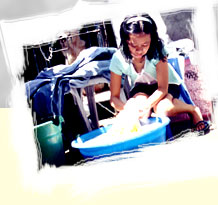
Mr. Speaker, my esteemed colleagues, I stand before you today on a matter of great significance to the small. The small, who are everywhere in our lives, but nowhere mentioned in our concerns and even our everyday talk. Certainly, these small people are never considered in our grand and pretentious deliberations on the national and its present tribulations. Yet, these people and the families they support through work of great suffering and indignity are among the worst victims of the current economic collapse. Make no mistake about it, we are in the midst of an economic meltdown that was denied by the President in his last State of the Nation Address, but has since been invoked by the President in self-defense for deteriorating condition of the country and his plunging popularity. I refer to that sector of our society, the Negros of a colored nation, whose efforts to uplift themselves from the morass of poverty continue to be denied the basic protections already enjoyed by the rest of the working classes. This has rendered them specially vulnerable to abuse, insult and exploitation. I refer to our maids, our atchays, our katulongs, the last slaves in a Christian world tormented by screaming matronas who worked them to total fatigue, and sometimes molested by the horny men of the house, including drivers. I refer to a social anachronism from feudal past and manorial economy that has no place in modern society. Yes, there is need for household help. It is Filipino maids in Hong Kong that enabled its skilled and energetic population to devote itself full time to their personal success and progress of their economy. But they see the household help there as integral to that economy as they are themselves, workers in common national development, commensurately paid for the essential services. Here, even the pittance they earn are paid grudgingly as though it were charity. To a niggardly wage, the Filipino household add, quite often, not kindness but shame. There are no masters where there are no slaves, said our national hero. On the other hand, this humble representation maintains that there are no worse masters than former slaves. And are we not all descendants of slaves? Allow me to relate to you a chapter in the life of Len-len Pebrero, a chapter that saw light only through the efforts of the Visayan Forum Foundation and the Probe Team. A chapter that the girl would rather forget as a bad dream, but still continues to haunt her like a living nightmare. Len-len is a fourteen-year-old barrio lass from Sta. Fe, Leyte. Typical of other girls and boys in the provinces of her age, Len-len dreamed of a better life outside the small and confining community in which she grew up. A free and spirited where she could work for more than the day's daily bread, something people out in the provinces still believe about Metro Manila. Recruited by a town mate to work as a maid in Manila, Len-len's parents reluctantly let her go. They were assured that Len-Len's employers treat her like the child they never had. Len-len found herself working nineteen hours a day, seven days a week, from four o' clock in the morning through eleven o'clock in the evening. From the threadbare safety of her nipa hut in Sta. Fe, Len-len was pushed into the manorial abuse common in the mansions of Manila and shown the dark side of the uneducated personality. For the smallest infraction of a changing set of impossible rules, she was denied her meals. She developed a cringing familiarity with the heavy hands of her employers. "Mas gugustuhin ko pang mamatay kaysa magdusa rito. Para akong hayop kung tratuhin. Plano ko nang mamatay." Len-len relates in her native dialect. On her third try, Len-len escaped from her Alcatraz, she has since then received medical attention for the wounds on her body, though no medicine can ever reach the scars in her soul. The story of Len-len is neither no fiction nor an episode in a TV soap opera. It happens everyday in many households. We know why they go just the same. Life in the countryside is getting only worse. We know now why they stay in these households of horror - to be able to earn a little something to alleviate the misery back home to be able to say with pride that they were able to support their families back in the provinces. They are the best, the most giving and least demanding of our race. They are the worst treated in our nation. To be sure, there are many that find a decent wage and experience humane treatment in the households that receive them. Some become extended members of the family, cared for and loved. But these cases cannot justify inaction with regards to the others. Buried in the inside pages of newspapers today, are small items quickly read and faster forgotten about the horrors inflicted on help in many homes. This phenomenon crosses the social spectrum. From the mansions to the apartment houses of the struggling lower middle class, the same horrors are visited on the most helpless members of our society. We ourselves are not strangers to horror stories told about household helpers physically, sexually and mentally abused by their employers. There is this household helper who was forced by her employer to drink a bottle of liquid sosa - a corrosive chemical compound used to clear clogged drainpipes. She suffered months of excruciating pain before mercifully passing away. There was another household helper who was being sexually abused by her employer on a nightly basis, believing in all naivete that this was part of the unspoken terms of her employment. And there is the story of a household helper who, for or no apparent reason at all, was attacked and almost killed by a member of the family she was serving. These are not fictional stories from the Old American South. These are stories all too sadly common in a free and Christian society. Countless more stories of pain and suffering continue to circulate by word of mouth or by tabloids and in the police pages of the newspapers. They happen because the government does not care and the people affected have no legal means to defend themselves. A hundred and fifty years ago, a great man told his people that a house divided will not stand, and a nation cannot continue existing half-slave and half-free. Abraham Lincoln liberated the slaves in the United States. One hundred and fifty years later, a former American colony, heir to its liberation tradition continues to host in a thin disguise virtually the very same slave institution. This cannot continue, and it is not because a house divided will not stand. Our household helpers are too weak and politically inconsequential to make a dent on the power structure of an unjust society. It is because we should not allow it. For the degradation and abuse to which these helpless members of our society are subjected degrade us even more and impoverish our spirits. In do not propose the abolition of household help. I do propose the elevation of what is an essential part of our daily living and daily working, to the dignity and protection it deserves. Maids work alongside with us, they are not supposed to slave under us. They are, by reason of their closeness to us, extended members of our households. It is for this very reason that the word 'kasambahay' or 'kasama sa bahay' has evolved to better describe the affinity between the homeowner and the home companion. A term of endearment and respect that I would encourage everyone to use in reference to our home companions. After all, let's face it, it was our yayas who raised us from infancy. Ladies and gentlemen, the institution of kasambahay is a dignified employment. It assumes the fullest trust and confidence of the homeowners in the person to whom they have completely opened up their house and surrendered their daily well-being. We leave our wallets, our wives leave jewelry, just anywhere at home and ask our maids to get them for us. Would we do the same in this House? Beyond providing for the daily demands of the household and its constant maintenance, kasambahays contribute not insignificantly to national economic growth and productivity. This is recognized in Hong Kong and Singapore to which our maids go. It is still ignored where they came from. By giving their employers more time for economic activities, either through entrepreneurial pursuits or as more productive members of the labor force, kasambahays act as an efficient and effective productivity multipliers. Furthermore, kasambahays, in their role as a direct source of financial support for their dependents in the countryside, effectively create significant economic well-being in the less developed areas of the country. And yet, custom and conventions continue to relegate kasambahays to the bottom of the economic ladder. And the law continues to regard them as an informal sector of the labor force, specifically excluded from the basic rights, protections and privileges accorded to the other members of Philippine labor. Even where the laws might protect them as human beings, the hidden nature of the household helper industry - where the masters and servants closely interact - makes many of the most common legal protections unavailable. What is rape is disbelieved, what is assault and battery is politely ignored by the police who come to investigate the screams in the night only to tip their hats to the amo (master) with apologies for interrupting them. The worse of course, is the mental abuse from the constant, unrelenting and tormenting, nagging that the Filipino housewife, especially of the old generation, can raise to the level of an art form. Compounding this problem of abuse is the basic character of the kasambahays themselves, who have little or no awareness or understanding of their basic rights and privilege as just plain human beings. My respected colleagues, it is difficult enough for the government in these troublesome times to cascade the benefits of economic productivity to the less privileged sectors of the society. But an improvement in living conditions, among those who have hardly enjoyed it, can be achieved without government largesse. It could be accomplished in part by an extension of legal protections and by means other than financial remuneration per se. Particularly, in the case of the kasambahays with whom every peso counts, but no amount of money can make up for what they must endure from the mouths and hands of their masters. They need the kind of protection afforded by law to other workers. Let us do our share by legislating laws that will improve, if not the standard of living of our household help, at least the conditions of their existence. If we cannot yet lift them from the morass of poverty, we can at least release them from what are, in effect, prison cells and torture chambers. Today, I am submitting for the approval of this august body, a Magna Carta for Household Helpers, a Batas Kasambahay. A small step in the road towards the full emancipation of our household help, but a big one in their self-awareness and self-respect. The Batas Kasambahay seeks to institutionalize and uplift the minimum working parameters and standards of the local kasambahay industry. Our objective is to strive to bring this traditionally informal sector closer towards the benefits and protection accorded by law to the more formalized sectors of the labor force - without losing sight of the peculiarities traditionally inherent in the relationship between homeowner and the kasambahay. The proposed Batas Kasambahay seeks to redress the grave injustice levied against this relatively significant part of the Philippine labor, by providing the basic structure that would uphold their dignity and respecting the desire and the need of the homeowner for the austerity in these trying times. As members of the extended family, it is recognized that the relationship between the homeowner and the kasambahay transcends that of a simple employer-employee relationship. It is nonetheless the duty of the state, to bring about the minimum working parameters and standards that will ensure the protection and well-being of both the employer and the kasambahay, and to promote the harmonious and productive relationship between both parties. Honorable colleagues, my dear friends, Our countrymen need our help. This piece of legislation, this Batas Kasambahay is not a law to be authored by me alone. This is our bill, a bill of the Eleventh Congress that will be passed to serve the very people that elected us to office. A bill that should be passed in order to correct a social imbalance that persists even to this day and age, A bill that seeks to promote the safety and welfare of the kasambahay, without unduly adding to the burdens of the average homeowner in these austere times. Yesterday, we commemorated the memory of our national heroes. Today, let us do something concrete to alleviate the life of our unsung heroes - the Kasambahays. Let this be our pamaskong handog to the people that help make our lives a little bit easier, a little bit more comfortable. Let us help our people realize their dreams and aspirations, ladies and gentlemen. It is the only honorable thing to do. Thank you, Mr. Speaker, my dear colleagues for hearing me out. December 7, 1999 |






