 |  |  |
| |||||||||||||||



| |||||||||||||||||||||||||||||




| |||||||||||||




| ARTICLES (ARCHIVES) Discrimination
Behind Closed Doors: Presented By Ma. Cecilia Flores-Oebanda, Visayan Forum
Foundation, Philippines |
| When we talk of discrimination what generally comes to our mind is a formal
workplace relationship that affects adults workers. We seldom see how discrimination
everyday endured by child laborers because they are very young. Our organization
the Visayan Forum Foundation, an NGO working with the child domestic workers,
would like to share with you today their everyday experiences to contribute clarity
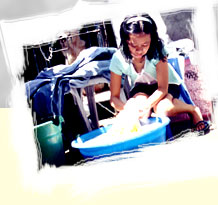
into the theory and practice of discrimination. Society in general often overlooks the sector of domestic workers. But what helps keep Asian family survive despite the increasing pressure of economic globalization? It is the everyday army to young maids, cooks, baby sitters who remain out of sight and out of mind while mothers and care for children in exchange for low salaries that they remitted back to their poor families in the rural areas. In the Philippines for example, we estimate that if at least one million workers in this sector were to remit at least half of their average salary of US$16 a month, they would be silently infusing more or less $96 million a year to their poor families in the provinces. In short we fail to recognize these hidden workforce multipliers' economic contribution to our daily life and to our countries' development, they still remain invisible and neglected and for me this is discrimination. The practice of employing young girl domestic some is still deeply rooted and common not in the Philippines but also in other countries specially in Asia, Africa and Latin America. Some started to work as young as 9 years old. They are not even covered by laws. Many call them "a difficult sector to work with," but the bottom line is, even in our work for social justice, we have discriminated our domestic helpers. Child domestic workers work an average of 15 hours daily, and are on call 24 hours a day. Days off are limited to one day each month; many have no day-off at all. Confined to repetitive, menial work, most of these children have no opportunity to acquire life skills that would help them grow into productive adults. Working away from her home, the child is separated from her family for extended periods of time. She and many others like her are prohibited from communicating with their families. The child is thus under the complete control of her employer, who does not necessarily serve the child's best interests. The child's freedom of movement is also limited. Isolated from family and peers, they rarely leave even when they suffer abuse. These children are among the lowest paid workers, receiving an average of PhP 800 (US $16) a month - if paid at all. Many begin there working life in debt bondage to recruiters who paid their transportation and lodging on the way to the employing household (two to three months' worth of the child's wages). The child is then trapped into debt, and thus into bondage. CDWs often endure inhumane treatment. They suffer insults on a daily basis Many are beaten, some even to the point of death. There are cases where the tormenting employer's creativity exempts his or her acts from being called beatings: one child domestic died from being forced to drink a liquid used to unplug drains. Another child was forced to drink bleaching liquid each time she failed to wash all the laundry, ostensibly as a form of discipline. One was made to kneel on a stool for hours, while balancing a fire extinguisher on her outstretched arms. Girls are sexually molested, usually when their duties include giving their employer a massage. Some are raped, after an escalating series of molestations. Invisible and isolated, overworked and underpaid, deprived of the opportunity to study and to play, verbally abused day in and day out - this is how many child domestic workers live. In the worst situations, they are abused to the point of death and hopelessness. If all of these are not called acts of discrimination against their personal essence and humanity, what then are they? For us, this is discrimination. The relevant question is now therefore: how do we deal with discrimination? Visayan Forum Foundation is a national NGO that has been working with ILO-IPEC Philippines for the past five years to provide a comprehensive set of direct services and social protection for child domestic workers. It also works for their empowerment and promotion of self-help organizations, and to advocate for employment policy and programmes. In this regard, VF has been creatively engaging with tri-partite partners in many ways. In the Philippines, the government is now helping us to address the statistical invisibility of the sector. The labor department with the leadership of our Secretary Patricia Santo Tomas is setting up national programs and action to target child domestic workers as priority group for the national time-bound program to implement ILO Convention 182. Legislative bodies are now also working on to enable a magna carta for household helpers seeking to institutionalize and uplift the minimum working parameters and standards for the industry. Other government agencies such as the Philippine Ports Authorities have also set up two shelter houses in strategic ports to combat traffickers of children. Employers group headed by Philippines Confederation of the Philippines helps us reach out with some enterprises specially the shipping industry opened opportunities to educate frontline crews and ground staff to directly deal with the problem of trafficking in ports. VF works also with department of education to encouraged the accreditation of non-formal alternative schemes such as week-end and night schools that we are now working with to reach out and assist working children, a majority composed by domestic workers. The Social Security System campaigns and works in the field to register domestic workers. Media institutions have actively exposed abuses balanced with positive information on how employers can humanely treat their domestic workers. We have started to seek the help of trade unions to formalize the sector. They are very supportive in lobbying to the government for greater attention to the informal sector and women's participation. At the ground level, trade unions help monitor the trafficking of women and children into domestic work and prostitution as they pass through entry and exit points such as ports. Together, we are also now beginning to explore concrete ideas to make freedom of association a reality by unionizing domestic workers in the long-term. This ensures that the work is a legitimate and dignified occupation, not just a peripheral job. In conclusion and thank you very much, let me say that if we talk about discrimination let us transcend the boundaries of formal labor and adult work. Let us try to examine more closely the world in which our millions of child laborer are trapped at this very moment. Amid the worsening effects of economic instability and boiling labor problems, let us deal with the issue of discrimination in a manner encompassing. In the end, everybody is responsible, not just the State. Of course, the State must demonstrate its moral force to make actions against discrimination a social priority. But we need each other's help. That way, NGOs can help enrich the battery of experiences of the tripartite partners. To enrich and sustain our efforts to eliminate all forms of discrimination in this generation, this is the only way. Thank you and mabuhay! |






