 |
 |
 |
|
|||||||||||||||



|
|||||||||||||||||||||||||||||||||||




|
|||||||||||||




| ARTICLES (RECENT)
Regional Multidisciplinary Workshop on Child Domestic Workers
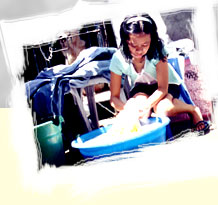
Child domestic workers (CDWs) is a special group of working children because they are very scattered, highly invisible and are very difficult to protect. They spend their working time 15 hours daily, and are on call 24 hours a day. Days off are limited to one day each month; many have no day-off at all. Confined to repetitive, menial work, most of these children have no opportunity to acquire life skills that would help them grow into productive adults. While not all CDWs work in hazardous conditions, studies have shown that many CDWs suffer under worst practices and working conditions. Many CDWs are sold or trafficked. Many work in bondage or without pay. Most of them work for long and indefinite hours often in isolation and usually at night. Many are exposed to grave physical and emotional risk and health hazard. They are mostly girls, and are working away from home. Many child domestic workers can therefore be found in worst forms and conditions of child labor. |
|
Since 1995, Visayan Forum Foundation (VF), a national NGO, has worked intensively on the issues of child domestic workers and their adult counterparts. Its Kasambahay Programme has expanded in scope of its integrated services in four CDW-concentrated cities: Metro Manila, Batangas, Bacolod, and Davao. The International Labour Organization, through its International Programme on the Elimination of Child Labour, shall implement the Project "Supporting the Time-Bound Program on the Elimination of the Worst Forms of Child Labor of the Republic of the Philippines" from 2003-2006. The Project shall assist the Philippine Government's National Program Against Child Labor to achieve its goal of reducing the number of Filipino children in the worst forms of child labor by 75% by year 2015. Following the agreements reached through a series of consultations involving ILO's partners (in government, workers organizations, employers and NGOs), the Project will focus on six priority groups: child domestic workers, children in prostitution, pyrotechnics, deep-sea fishing, mining and quarrying, and sugar plantations. Programme interventions for these groups of child laborers shall be focused on eight provinces/areas: Camarines Norte, Bulacan, Cebu, Negros Oriental, Negros Occidental, Iloilo, Davao and three cities in Metro Manila. National interest in and concern about the situation of child domestic workers has risen exponentially. However, heightened awareness of the issue is not being matched by regional and local level action, and for this reason organizations like the Visayan Forum have been currently working to disseminate 'good practices' aimed at raising the profile of child domestic workers at local levels, and building capacity of local NGOs in developing a range of action against the exploitation of child domestics. In responding to the challenge, many organizations still fail to recognize and include CDW in their policies and programs. They consider child domestics as peripheral targets for many existing direct programs. There are several concerns that need to be addressed:
While efforts by partners are still limited, there are many opportunities that could generate multi-sectoral support from different stakeholders. It is important to help build capacity of other organizations in dealing with the issue and ensure the accessibility of their programs to CDWs. In this light, the multi-disciplinary workshops involving potential partners in regional PTBP areas become most important at this stage. Generally, the workshops aim to strengthen synergies among partners through the development of a comprehensive understanding of the issues on child domestic work. Specifically, the workshops hope to fulfill the following:
How will the consultations be organized? Separate workshops will be scheduled for the following areas: Manila, Bulacan, Batangas, Camarines Norte, Negros Oriental, and Davao. In some of these areas (Batangas and Bacolod), the write-shop on local legislation for local domestic workers will be incorporated. The output of this write-shop will be a draft resolution or ordinance on domestic workers in general, with specific provisions on child domestic workers, which can be submitted for adoption by local government units. For each region, VF will coordinate with local offices and partners to set up one-day consultation workshops. Coordination with representatives from the Department of Labor and Employment will also be very crucial, especially in the selection process and invitation of participants. Considering that positive contribution of these workshops to the planned Rapid Assessments currently contracted out by ILO-IPEC, the Visayan Forum will be closely coordinating with consultants hired to carry out the researches. It will be crucial that the initial secondary data gathered during these assessments will be utilized and presented to the participants. Any organization wishing to facilitate this data-gathering process will be most welcome. Finally, invited participants are also highly encouraged to visit the website www.visayanforum.org which has extensive materials uploaded about the child domestic work issue. Any organization that is willing to contribute to the aims and activities of the Philippine Time-Bound Program on the Worst Forms of Child Labor under the National Program Against Child Labor. Since the consultations will be held in selected cities, the organizers will invite representatives coming from adjacent PTBP. For example, the Bacolod Consultation will explore the possibility of involving some participants from Iloilo and Dumaguete. The consultations are just initial steps towards a longer-term programmatic action on child domestic work in the Philippines. The participants are expected to come up with action plans and shall continue to make collaborative efforts within the regional partnerships of the National Program Against Child Labor. Visayan Forum is facilitating this exercise to discuss, fine-tune, and advance programs on child domestic workers. Furthermore, the consultation will be a venue to identify areas of collaboration and sustained partnership. These consultations will be comprehensively documented and would provide information on the Kasambahay program run by Visayan Forum and lessons for the running of similar programs elsewhere in the country. For more information, please visit our website www.visayanforum.org
|






