 |  |  |
| |||||||||||||||



| |||||||||||||||||||||||||||||




| |||||||||||||




| ARTICLES (ARCHIVES) Keynote Address
During the 2nd Regional
Consultation on Child Domestic Workers in Asia |
| To the honored guests in the front table, from our partners in government,
our partners from the multilateral agencies, and our NGO partners and to all of
you who have come from different parts of Asia to be with us here "Isang
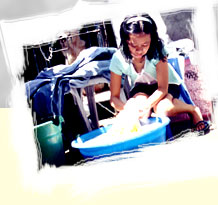
Magandang Umaga, Salamalaikum," a Very Good Morning to all of you! First of all, I would like to welcome all of you in behalf of the president, Gloria Macapagal Arroyo. As you know, she used to be the Secretary for the Department of Social Welfare & Development and one of the many initiatives that she had supported is to make sure that the rights and the welfare of children are protected and one of the key issues that she has worked for is the protection of children in difficult circumstances which include children who are in the child labor sector. Also, I think it would be very appropriate at this point to point out that we have been very active both as a government and as an NGO sector in providing the best practices for the country and the rest of the region in the struggle against those who have perpetrated this practice. I think one of the anomalies of most of our societies is that we say we love children, we respect children, we take care of children but because of the poverty, the situations that most of our countrymen and women find themselves the love for children translates to selling them for prostitution, the love for children translates to selling them to do housework or if not sell them, allow them to be used, the love for children translates to payment for debts, debts that have been there in our families for generation. That is the anomaly of our societies today. If this anomaly is perpetrated because of the economic and social injustices that exist in our countries today and I think it's appropriate that you who are witnesses to these, either because you have been a victim yourself as a child domestic worker who have broken free from that bondage or you who are advocates so that the rights and welfare of children be protected are here once again to reflect and to fit through what could be the things that we could do together, the activities that we could push together so that we can transform this situation. At the outset, I would like to congratulate you and the organizers because this effort provides a beacon of hope for many who continue to still struggle especially for the victims who have broken free from their bondage, your efforts tells us that victory can be achieved. For our part in the Philippines, I would like to say that the Philippine government as you can see here by the presence of the line agencies, the Department of Labor & Employment and the Department of Transportation and Communication are committed to promote the rights and welfare of children particularly address the issues that are co-pertaining to Child Domestic Workers. In the department I worked with, the DSWD together with DOLE because we are partners and they are the lead in our work of protecting the rights of child domestic workers. We provide the psycho-social, the stress de-briefing and the contact to the families upon rescue from situation of child labor conditions. We actually have a program that undertakes rescue of these children and we work closely with the non-government organizations present here so that we can actually identify areas and provide the actual rescue from the children. But we know that that is short term and that is not going to solve the problem. We will continue to rescue if we do not address the structural and systemic problems that we face. This is why we support the bill called "Batas Kasambahay" or the Domestic Workers Bill that will be protecting the rights of children and making sure that our domestic workers are not children. And this is very important because many of, I think, our societies extend our family and in the extension when children come to live with us work automatically is given to them. There is no more distinction between a gratitude action because you provide shelter and the fact that the family who provide the shelter is actually using and abusing the time and that person because you have actually treated now the child whom you said you would care for as a domestic worker. So the bill hopes to address many of these gray areas and bring to mind to those families who provide shelter that these children that we're taken care of have rights and that these rights must be protected particularly that they must if you take someone in your care have compulsory education and that in fact they should not be employed because our law here in the Philippines says 15 years old and below should not be in any employment. They should enjoy their rights as children to education, to play time, to the visions that we've heard, to the dreams that we've heard articulated by the children earlier. We also have committed to enforce, strengthen our inter-agency coordination. We already are doing that but as in any bureaucracy we have to make sure that the people at all levels are working together especially at the level of the villages and the towns because that is where the challenge occurs. It's not in places like these as you know, it's not in the national capitals, it's not in our offices in the cities the challenge of being able to deliver the basic social services and ensure the children's rights are protected in the villages, in the towns, in the urban-poor areas. We also commit to work hand in hand with the non-government organizations particularly NGOs who have been in these struggle for a long time. I'll pride and it's a privilege to say that before I joined government I have been working with the groups here who are working to eliminate child labor and particularly we have been working with child labor groups who are working in parts of Metro Manila that was on the cutting of stones and have been working with the local government unit to protect the children from these types of labor practices. I think at this point, it is important to also point out that without the energy and the initiative of many of the NGOs and peoples organization to address the more systemic problem of poverty, child domestic labor will not end. And we support that and we see that in the government. In other words, we have to make sure that the policy environment and the actual programs to address poverty because once we eliminate poverty children can actually have schools, playgrounds, and time to play, time to study and not be brought to places where they will do hard work. I think the commitment of the Macapagal Arroyo government to this end is not only for these laws that I mentioned that we support. These programs I mentioned that we will undertake but it is also in line with supporting the Philippine Time Bound Programme because only in targets and only in measurable outcomes can we really be able to ensure that the future of the children today and their children's children are going to be one where a truly compassionate society is alive, where truly justice is the norm and the struggle for child domestic workers does not exist. I wish you all the best in your conference in the sharing and the reflection and I hope you would have reinvigorated yourselves and the strategies that you will undertake to ensure that the rights and welfare of children are protected in Asia. Thank you very much and a good morning to you. |






