 |  |  |
| |||||||||||||||



| |||||||||||||||||||||||||||||




| |||||||||||||




| VIDEOS Out of Sight, Out of Mind
|
| Abstract This video was produced by Anti-Slavery as part of its campaign on child domestic workers in the Philippines. Made with local NGO Visayan Forum, this video was shown on TV and in Congress in the Philippines. This has led to the drafting of a new law which will protect child domestic workers. Interviewees: About Len-Len
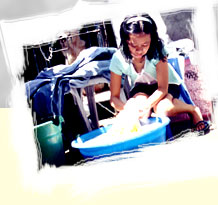
Recruited by a town mate to work as a maid in Manila, Len-len's parents reluctantly let her go. They were assured that Len-len's employers treat her like the child they never had. Len-len found herself working nineteen hours a day, seven days a week, from four o' clock in the morning through eleven o'clock in the evening. From the threadbare safety of her nipa hut in Sta. Fe, Len-len was pushed into the manorial abuse common in the mansions of Manila and shown the dark side of the uneducated personality. For the smallest infraction of a changing set of impossible rules, she was denied her meals. She developed familiarity with the heavy hands of her employers. "Mas gugustuhin ko pang mamatay kaysa magdusa rito. Para akong hayop kung tratuhin. Plano ko nang mamatay." (I would rather die than suffer. They treat me like an animal. I wanted to die.) Context of the Video Documentary (Overview) In April 1999 Anti-Slavery began a project, which set out to raise the profile of a type of child labour that could be considered under the proposed International Labour Organisation Worst Forms of Child Labour Convention. With the new Convention due to be adopted in June 1999, the project aimed to test the Government of the Philippines' commitment to this new Convention. The project was funded by Oxfam and Anti-Slavery, and carried out by the latter with Visayan Forum, the leading Philippines NGO working on migrant child labour issues. Anti-Slavery and Visayan Forum decided to focus on child domestic workers because the issue was not well understood by the Government of the Philippines, nor was it treated as a priority issue. Domestic work is probably the largest source of employment for girls world-wide, and in the Philippines - with a population of 70 million - an estimated one million girls are working as domestic servants. While the work is hard and tiring, it is not the tasks themselves that make some child domestic work slavery or servitude. It is the conditions in which some girls are employed which make this kind of work unacceptable. With regard to the ILO Worst Forms of Child Labour Convention, Anti-Slavery and Visayan Forum particularly wanted to highlight the fact that a girl is separated from her family and under the complete control of her employer, and that a child domestic can be on call 24 hours a day. The fact that the girls are employed in the privacy of other people's homes, makes the problem hidden and the girls particularly vulnerable. In April 1999 Anti-Slavery's press officer spent two weeks in the Philippines working with Visayan Forum, a camera crew and a film editor. The team produced a campaign video, a video news release and collected photographs and case studies to use in other campaigning materials. |






