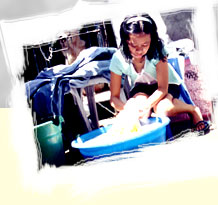
We thank you for your relentless and dedicated efforts to help pass the Magna Carta for Household Helpers. However, it still faces difficulties in the Senate and a looming deadline before the elections come May 2004. To help spread the spirit of the magna carta, click the poster and sticker icons below to have your own print ready copies at home.

VIDEOS

Trafficking at the Manila Port
Produced by: UNICEF
Language: English/Filipino
Available in undubbed version
8 minutes

Shot July 2001:
Highlights:

  • Coastguard, police and NGO operation to intercept children at risk in port of Manila
  • Children being taken to hostel by NGO that protects children at risk of trafficking
  • Interviews with UNICEF, coastguard and International Labour Organization (ILO) officials

Video script/narration:

It's night in the Manila Port area. Never a good time for women and children to be on the streets alone. Yet day and night thousands of women and young people arrive here in search of work to support their families back home in the provinces. According to Visayan Forum, an NGO which works to protect new arrivals, Manila Port is the last place where vulnerable women and children are visible and can be helped. Once they leave this area, they simply vanish into the city offering a myriad of low-paid and often illegal opportunities to earn money -- from factory jobs and domestic service to bar work and prostitution.

Tonight, Visayan Forum's Founder and President Cecilia Oebanda is talking to some of the organization's many partners in the battle to protect women and children from the pimps and recruiters who operate in the port area. Manila Port's Security Guards can play a vital role in identifying and protecting vulnerable young people. Addressing their pre-shift roll call, Cecilia Oebanda explains that Visayan Forum operates a Halfway House, and they can bring in any young people or women they think are in need of a safe haven.

Cecilia Oebanda:
For me it is unacceptable just to close our eyes when we know that children, day and night, (are) coming to the port and we don't know what happened to them. And we also know that there are vultures there waiting for those children to become their prize.

Nineteen-year-old Beth Gonzales knows what it is like to be exploited. She was left without a home after she fell out with the people who employed her as a domestic servant. She fell into conversation with a woman who offered her a place to stay. Before the end of the evening she had been drugged and the woman had sold her virginity to a merchant seaman on a visiting ship. She was only seventeen years old then and it took her a whole year to get out of sex work.

Beth Gonzales:
I cannot accept what happened to me. I am ashamed of myself. I lost my virginity. I lost my future, I lost my hope. (Interview at the Third World Movement against the Exploitation of Women, an NGO which seeks to protect those working in prostitution, and help them build a new life.)

Another key partner in the battle to protect the young from being trafficked to Manila for illegal work, is the Philippine Coast Guard Commander Jose Cabildo and his crew are on their way to intercept a Manila-bound ferry. They believe a young girl reported missing by her parents might be on board. Once the ferry has docked and the passengers disembark, she will be hard to spot. The chances of finding her before the vessel docks are better. After patrolling the passenger decks, Commander Cabildo questions a young girl who seems to be alone but turns out to be accompanied by an aunt. She is not the girl he is looking for.

There are some 7,000 islands in the Philippine archipelago and every year around five million people, as many as half of them young girls and women, arrive at Manila Port by ferry. Alfonso Cusi is General Manager of the Philippine Ports Authority, a crucial partner of Visayan Forum.

Alfonso Cusi:

For unguided children to be in Manila is a big problem. We in the Ports Authority are aware of that and considering they are passing through our ports we believe we have a social responsibility to prevent them from coming into Manila, especially if they are not properly guided.

After a 24-hour trip from Cebu City in the Visayan region of the Philippines, the passengers are probably pleased to hit dry land. But Manila Port is a bustling, frightening place for new arrivals.

As they exit the ferry terminal they are met by people offering transportation and jobs.

Among their ranks are recruiters and pimps looking for young girls to place in sweatshops, domestic work or the capital's many bars and brothels.

It is here at the port's arrival terminals that Visayan Forum workers like Jennifer Tangcay (in orange shirt) try to identify potentially vulnerable young people and offer them help. This may be general advice, temporary accommodation or just a telephone number to call if they need help during their first few days in Manila. Jennifer and her colleagues call these operations "roundings" and they often work together with the Ports Police to scan arriving children and see who might need their help. Today, Jennifer has spotted a group of young boys and girls who seem to be being trafficked. The young people all claim to be over 18 but Jennifer and Ports Police officer Antonieto Tarrayo think they are lying and ask them for proof which they don't have.

Ports Police Officer, Antonieto Tarrayo:
I think this one is not telling the truth about her age. She told us she is 18 but she looks 16 or 15 years old. Young people who are being trafficked are surprisingly easy to spot. Often they have been recruited in their home towns and arrive in groups accompanied by a single adult minder who intends to place them in jobs (confirmed or as yet unfixed) in the capital. They are usually under strict orders to stick together and tell anyone who asks that they are 18.

If the police cannot verify their ages or believe they may be bound for illegal work then they are taken to Visayan Forum's Halfway House. There the workers can try and contact the children's parents and look after them until their promised jobs can be verified. Understandably, it is a harrowing time for the young people.

It is hard work for Visayan Forum, too, and they can't manage it alone. They work closely with others, from different sectors of work, who all have a role to play in the fight against trafficking: the Ports Authority, ferry companies, the Coast Guard, Port Police and security guards. Visayan Forum is licensed by the Department of Social Welfare to provide secure temporary care for minors as well as counselling and other services, and is supported by the ILO and UNICEF.

Cecilia Oebanda:
The effort that we are doing in the port is actually in partnership with a lot of organizations like the Philippine Ports Authority, the police, the UNICEF and the ILO and other agencies of the (Philippine) government to give immediate services and protection to the children who are freshly trafficked from the regions. Cecilia shows Carmella Torres National Programme Manager of ILO's International Programme for the Elimination of Child Labour and UNICEF's child protection officer Victoria Juat the latest arrival figures.

Carmella Torres, National Programme Manager of ILO's International Programme for the Elimination of Child Labour:

Children below 18 years of age are target groups and they are very vulnerable groups and once they are exposed to a place which is very new to them with no relatives or friends around, they can be placed in a situation of work where they can exploited, abused or even sexually exploited.

Once the children have had a chance to rest in the Halfway House dormitories, Visayan Forum workers conduct a "getting to know you" session to help the young people relax and to gain their confidence. Later, many of these young people admitted they were younger than 18 and Visayan Forum was able to find them places in a three-month training programme run by Educational and Research Development Assistance. This will help them to gain skills that will better equip them to find a job at the end of the course.

Shot Sequence

  1. Streets around Manila Port area at night. Young woman walking along road

  2. Boy playing on pedal cab in front of incoming truck

  3. Port Security Guards parade before going on duty

  4. Cecilia Oebanda, President of Visayan Forum, addressing Security guards about the issue of trafficking and the need to protect vulnerable young people

  5. Security guards listening

  6. Cecilia Oebanda, President of Visayan Forum, interview: For me it is unacceptable just to close our eyes when we know that children, day and night, (are) coming to the port and we don't know what happened to them. And we also know that there are illegal recruiters, there are vultures there waiting for those children to become their prize" (English)

  7. Beth Gonzales, exploited as a child and now,aged 19, walking down the street.

  8. Interview with Beth Gonzales: I cannot accept what happened to me.I am ashamed of myself. I lost my virginity. I lost my future, I lost my hope. (Visayan)

  9. Philippine Coast Guard patrol boat on its way to intercept a ferry

  10. In wheelhouse / Commander Jose Cabildo on the radio

  11. Stern of ferry

  12. Commander Jose Cabildo prepares to board ferry

  13. Commander Jose Cabildo and his armed officers patrol ferry in search of minors being trafficked to Manila for sex work

  14. Commander Jose Cabildo questions an unidentified young girl. (She was not being trafficked)

  15. Another ferry arriving in Manila Port (from Cebu City)

  16. Boys on home-made floats playing in water in front of ferry as it docks

  17. Interview with Alfonso Cusi, General Manager of the Philippine Ports Authority: For unguided children to be in Manila is a big problem. Wein the Ports Authority are aware of that and considering they are passing through our ports we believe we have a social responsibility to prevent them from coming into Manila, especially if they are not properly guided."(English)

  18. Passengers disembark from ferry in Manila Port

  19. Young girl walking out into port area

  20. Passengers' view of arriving in port / jeepney drivers and recruiters trying to attract attention

  21. Visayan Forum worker Jennifer Tangcay (in orange shirt) intercepts a group of girls / offers them help

  22. Working with Ports Police officer Antonieto Tarrayo, Jennifer helps interview the girls

  23. Ports Police officer Antonieto Tarrayo says: I think this one is not telling the truth about her age. She told us she is 18 but she looks 16 or 15 years old. (English)

  24. Exterior of Visayan Forum's Halfway House Silungan sa Daungan (or Shelter at the Port) at the Port where they offer temporary accommodation and refuge to trafficked minors and women

  25. Visayan Forum worker Marina Ullegue opens gate as Ports Police officer leads intercepted young people into Visayan Forum's HalfwayHouse intercepted young people received at Halfway House

  26. Young people in Halfway House

  27. Visayan Forum worker interviews boy about his age, status etc

  28. Dormitory accommodation / girls on bunks

  29. Cecilia Oebanda, President of Visayan Forum, interview: The effort that we are doing in the port is actually in partnership with a lot of organizations like the Philippine Ports Authority, the police, the UNICEF and the ILO and other agencies of the (Philippine) government to give immediate services and protection to the children who are freshly trafficked from the regions. (English)

  30. Cecilia Oebanda, President of Visayan Forum, with Carmella Torres, National Programme Manager for International Labour Organization (on left in black jacket) and UNICEF's Child Protection officer Victoria Juat (on right in purple shirt) looking at admissions book

  31. Interview with Carmella Torres, National Programme Manager for International Labour Organization (International Programme on the Elimination of Child Labour [ILO-IPEC]): Children below 18 years of age are target groups and they are very vulnerable groups. And once they are exposed to a place which is very new to them with no relatives or friends around, they can be placed in a situation of work where they can be exploited, abused or even sexually exploited. (English)

  32. A day later at the Halfway House, the group of intercepted young people are taking part in a "getting to know you" session clapping hands, singing and laughing

For more information about this videotape:
Dan Thomas, UNICEF, NY, Tel: 212-326-7075, [email protected]

For local copies of the tape:
Roland Pacis, Visayan Forum, Tel 5627810, [email protected]

Back to Main