 |
 |
 |
|
|||||||||||||||



|
|||||||||||||||||||||||||||||




|
|||||||||||||




| 2ND REGIONAL CONSULTATION ON CHILD DOMESTIC WORKERS IN ASIA
Organized by Visayan Forum Foundation
|
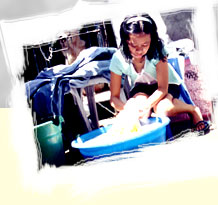
BACKGROUNDER Rationale Child domestic work is perhaps one of the oldest forms of child labor and is widespread in Asia. It is a crosscutting issue about child rights, child labor and gender. It is also related to a range of interconnecting issues. There are still long-standing practices and perceptions that give social acceptance to child domestic work. Factors such a globalization and the growth of middle class do contribute to the demand of child domestic workers. They suffer discrimination and hazards such as long an unspecified working hours, low or non-payment of wages, no social security, no security of tenure, no access to education, lost opportunities, no time for rest and play, inhuman living conditions, isolation, lack of family contact, total dependence on employer, and forced servitude. Verbal, physical and sexual abuses are still common. Their perceived low status is reflected in the various country-specific terminologies used to describe them. There are still cases of forced child labor to repay family debt. There is also a high incidence of deceptive recruitment and trafficking for work, including cross border movement. There are emerging trends and challenges in this sector. Child domestic work has always remained as one of the most prevalent yet quite hidden forms of child labor. Although it is not specifically stated as a worst form of child labor, there are many characteristics that noticeably fall under the conditions as embodied in ILO Convention No. 182. To date various countries, NGOs and INGOs have identified child domestic work as among the worst forms of child labor. This second consultation hopes to contribute experiential insights into the following themes: (1) Country extent, magnitude and modalities; (2) Child domestic work as a worst form of child labor; (3) Child domestic work as forced labor and trafficking issue; and (4) Discrimination. In terms of practical interventions, the sharing shall focus on (1) Education; (2) Direct services; (3) Working with employers; (4) Empowerment through sectoral approach, and; (5) Advocacy for social change. The consultation is more than just an advocacy event. More importantly it hopes to address the need for a stronger and more dynamic task force as the child domestic work issue needs to be put into the context of international debates as well to deliver concrete action. The consultation is thus a venue to come up with a workable regional action plan to be implemented in the next three years. |
OBJECTIVES As a way to consolidate and strengthen the capacity of the members of the Task Force on Child Domestic Workers (TF-CDW) in Asia, the consultation aims to:
It is a 3-day consultation with special side events. Prior to the consultation, there will be a special seminar supported by Anti-Slavery International on legislative work and policy advocacy focusing on Philippine experiences to lobby for a magna carta for domestic workers dubbed as Batas Kasambahay. On the last day of the consultation, participants will visit the Luneta Park (where Visayan Forum conducts Sunday field outreach to organize child domestic workers) and a halfway house, which is part of the anti-trafficking efforts at the Manila North Harbor. |
PARTICIPANTS Thirty-two (32) representatives of Task Force CDW from 10 Asian countries, and other international organizations directly involved in the issue of child domestic work. |
ABOUT THE ORGANIZERS Child Workers in Asia (CWA) was established in 1985 as a support group for child workers in Asia and the NGOs working with them. It now brings together over 50 groups/organizations working on child labour in 14 countries. It facilitates sharing of expertise and experiences between NGOs and strengthens their collaboration. Visayan Forum Foundation, Inc. (VF) is a Philippine-based national NGO established in 1991 to work for a society where marginalized migrants, especially the invisible working children, are free and empowered. Asian in perspective and local in context, VF also seeks to mobilize national efforts by advocating for policies and programs that sustain long-term social changes involving children, communities and other social partners. VF is currently the convenor of the Task Force. In November 1997, VF and CWA organized the First Regional Consultation on Child Domestic Workers in Asia. As a result, the Task Force CDW was convened to follow-up the serious concerns raised and the need for country-specific policies and actions. Shoishab-Bangladesh also hosted a regional exchange program for field workers in 1997. These events helped enrich the experiences of field workers and enhanced closer collaboration among them. Within five years, members gained positive results especially by setting up national programs and advocacy efforts in their respective countries. Global attention on the child domestic work issue has also grown. In this light, the second consultation in Manila becomes timely and important. |
STEERING COMMITTEE MEMBERS Visayan Forum Foundation Inc.
|
|






